

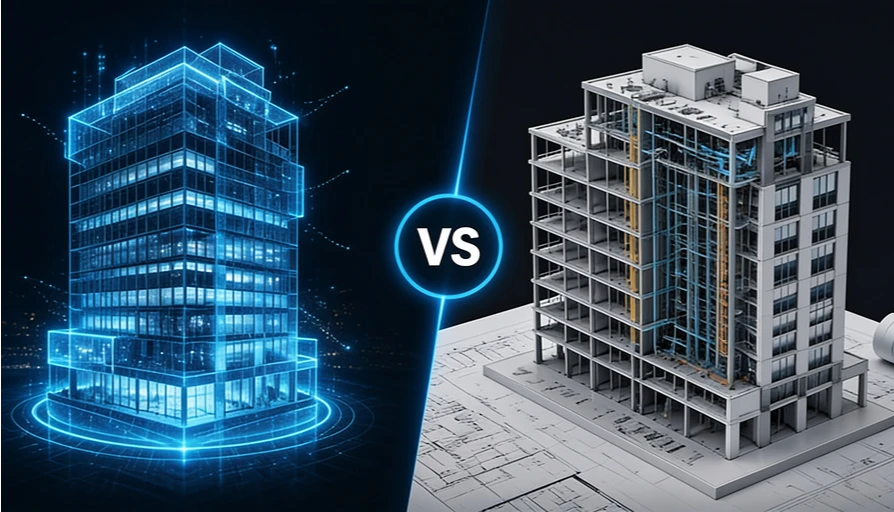
The construction industry has undergone a massive digital transformation over the past decade. Technologies that were once considered innovative are now becoming standard practices across architecture, engineering, construction, and facility management. Among these technologies, Building Information Modeling (BIM) and Digital Twin technology are often discussed together. While many people use these terms interchangeably, they are not the same. Understanding the distinction between them is critical for organizations looking to maximize project efficiency, reduce operational costs, and improve asset performance.
Think of BIM as the blueprint of a building’s digital world and a Digital Twin as a living, breathing version of that building that continuously updates itself using real-time data. BIM focuses primarily on design, planning, and construction, while Digital Twins extend beyond construction into operations, maintenance, and asset management. As organizations increasingly embrace smart buildings and Industry 4.0 technologies, the relationship between BIM and Digital Twins has become more important than ever.
Whether you’re an architect, engineer, facility manager, or project owner, understanding how these technologies work together can help you make informed decisions about digital transformation. This guide explores the differences, similarities, benefits, and future applications of Digital Twin vs BIM while helping you understand which technology is right for your project goals.
What is Building Information Modeling (BIM)?
Building Information Modeling (BIM) is a digital process used to create and manage information about a building throughout its design and construction phases. Unlike traditional 2D drawings, BIM creates an intelligent 3D model containing detailed information about architectural, structural, mechanical, electrical, and plumbing systems. Every component within a BIM model carries valuable data, allowing project teams to visualize and analyze the building before construction begins.
BIM has revolutionized construction by improving collaboration among stakeholders. Architects, engineers, contractors, and owners can work within a shared environment, reducing communication gaps and minimizing costly errors. Instead of relying solely on static drawings, teams can identify clashes, optimize designs, and simulate construction activities before breaking ground.
Another major advantage of BIM is its ability to support project planning and cost estimation. By linking building elements with scheduling and cost data, organizations can improve project forecasting and resource allocation. BIM provides a single source of truth during the design and construction phases, helping teams deliver projects faster, more accurately, and within budget.
Core Components of BIM
BIM models contain detailed information about building geometry, materials, systems, dimensions, and specifications. These elements are integrated into a centralized digital environment that supports collaboration and decision-making.
How BIM Supports Construction Projects
BIM improves project coordination, reduces design conflicts, enhances visualization, and enables accurate quantity takeoffs. It plays a critical role in project planning, procurement, and execution.
What is a Digital Twin?
A Digital Twin is a dynamic virtual representation of a physical asset that continuously receives and processes real-time data from sensors, IoT devices, and operational systems. Unlike BIM, which primarily represents how a building is designed and constructed, a Digital Twin reflects how the asset performs in the real world. It acts as a live digital counterpart that evolves throughout the building’s lifecycle.
Imagine having a virtual version of a facility that updates itself every second based on actual conditions. That’s exactly what a Digital Twin does. It monitors equipment performance, energy consumption, occupancy levels, environmental conditions, and maintenance requirements. This continuous data flow enables organizations to make proactive decisions instead of reacting to problems after they occur.
Digital Twins are increasingly used in smart buildings, industrial plants, airports, healthcare facilities, and manufacturing environments. By combining physical assets with digital intelligence, organizations can improve operational efficiency, reduce downtime, and optimize performance. The result is a smarter, more connected approach to asset management that extends far beyond the capabilities of traditional design tools.
Key Features of Digital Twin Technology
Digital Twins integrate real-time data, analytics, machine learning, and predictive insights to create a continuously updated representation of physical assets.
Real-Time Data Integration
IoT sensors provide live information about building systems, enabling Digital Twins to monitor conditions, identify issues, and support predictive maintenance strategies.
Digital Twin vs BIM: Key Differences
Although BIM and Digital Twins are closely related, their objectives, capabilities, and applications differ significantly. BIM focuses on creating and managing building information during design and construction, while Digital Twins focus on operational performance throughout the asset lifecycle.
One of the biggest differences is data connectivity. BIM models are generally static and updated manually when changes occur. Digital Twins continuously receive real-time data from connected devices, creating a dynamic representation of actual building conditions. This live connection allows facility managers to monitor performance, predict failures, and optimize operations.
Another key distinction is lifecycle coverage. BIM primarily supports planning, design, and construction activities. Digital Twins extend beyond construction into operations, maintenance, and long-term asset management. While BIM provides a detailed digital model, Digital Twins transform that model into a living system that evolves with the physical asset.
Purpose and Functionality
BIM is designed to improve project planning and construction coordination, while Digital Twins focus on operational intelligence and performance optimization.
Data Sources and Connectivity
BIM relies on project data and manual updates. Digital Twins integrate live sensor data, IoT networks, and analytics platforms.
Lifecycle Management
BIM primarily serves design and construction teams. Digital Twins support facility managers, asset owners, and operations teams throughout the building lifecycle.
Similarities Between Digital Twin and BIM
Despite their differences, BIM and Digital Twins share several important characteristics. Both technologies create digital representations of physical assets and improve information accessibility. They help organizations visualize building systems, support collaboration, and enhance decision-making.
In many cases, BIM serves as the foundation for creating a Digital Twin. The BIM model provides geometric and asset information, while Digital Twin technology adds real-time operational data. This relationship allows organizations to leverage existing BIM investments when implementing Digital Twin solutions.
Both technologies also contribute to improved sustainability and efficiency. By providing detailed insights into building performance, they help reduce waste, optimize resource usage, and support informed decision-making throughout the asset lifecycle.
Benefits of BIM
Improved Design Accuracy
BIM enables project teams to identify conflicts and design issues before construction begins. This proactive approach reduces rework, minimizes delays, and improves project quality. By visualizing building systems in a 3D environment, stakeholders gain a clearer understanding of project requirements and potential challenges.
Better Project Collaboration
BIM creates a shared digital environment where architects, engineers, contractors, and owners can collaborate effectively. Everyone works with the same information, reducing communication gaps and improving project coordination. This collaborative approach helps streamline workflows and supports successful project delivery.
Benefits of Digital Twin Technology
Predictive Maintenance
One of the most significant advantages of Digital Twins is predictive maintenance. By monitoring equipment performance in real time, Digital Twins can identify potential failures before they occur. This proactive approach reduces downtime, extends asset lifespan, and lowers maintenance costs.
Operational Efficiency
Digital Twins provide valuable insights into energy usage, space utilization, and system performance. Facility managers can use this information to optimize operations, improve sustainability, and enhance occupant comfort. The result is a smarter and more efficient building environment.
Digital Twin vs BIM Comparison Table
|
Feature |
BIM |
Digital Twin |
| Primary Purpose | Design & Construction | Operations & Asset Management |
| Data Type | Static Project Data | Real-Time Operational Data |
| Lifecycle Stage | Design to Construction | Entire Asset Lifecycle |
| Updates | Manual | Automatic & Continuous |
| IoT Integration | Limited | Extensive |
| Predictive Analytics | Minimal | Advanced |
| Facility Management | Limited Support | Core Function |
| Decision Making | Project-Based | Real-Time Operations |
Industries Using Digital Twin and BIM
Many industries benefit from BIM and Digital Twin technologies. Construction companies use BIM for design coordination and project management. Industrial facilities leverage Digital Twins to monitor equipment performance and optimize operations.
Healthcare organizations utilize Digital Twins to manage complex building systems and improve patient environments. Airports use Digital Twins to monitor infrastructure and enhance passenger experiences. Manufacturing companies rely on Digital Twins for predictive maintenance and production optimization.
Educational institutions, government agencies, transportation networks, and commercial real estate developers are also adopting these technologies to improve efficiency and support digital transformation initiatives.
How BIM Evolves Into a Digital Twin
The journey from BIM to Digital Twin begins with creating an accurate digital model during design and construction. Once the facility becomes operational, sensors, IoT devices, and building management systems are connected to the model. These technologies provide real-time data that transforms the BIM model into a Digital Twin.
As operational data accumulates, advanced analytics and artificial intelligence can be applied to generate insights and predictions. This evolution enables organizations to move from reactive maintenance strategies to proactive asset management approaches. The combination of BIM and Digital Twin technology creates a powerful foundation for smart building initiatives and long-term operational excellence.
Future of Digital Twin and BIM
The future of construction and facility management is increasingly data-driven. As IoT adoption continues to grow, Digital Twins will become more sophisticated and capable of delivering deeper insights into building performance. Artificial intelligence and machine learning will further enhance predictive capabilities, helping organizations optimize operations and reduce costs.
BIM will remain a critical component of project planning and construction. However, its role will increasingly extend into operational phases as organizations seek to maximize asset value throughout the lifecycle. The integration of BIM, Digital Twins, cloud computing, and smart technologies will create more connected and intelligent built environments.
Organizations that invest in these technologies today will be better positioned to manage assets efficiently, improve sustainability, and adapt to future challenges in the rapidly evolving construction landscape.
Conclusion
The debate around Digital Twin vs BIM is not about choosing one technology over the other. Instead, it is about understanding how they complement each other. BIM provides the digital foundation for design, planning, and construction, while Digital Twins bring that foundation to life through real-time data and operational intelligence.
Together, these technologies create a powerful ecosystem that supports the entire building lifecycle. From improving project delivery and reducing construction risks to enabling predictive maintenance and optimizing building performance, BIM and Digital Twins are transforming how organizations design, build, and manage assets. As smart buildings and digital transformation initiatives continue to grow, the combination of BIM and Digital Twin technology will become an essential strategy for achieving long-term success.
FAQs
1. Is a Digital Twin the same as BIM?
No. BIM focuses on design and construction information, while a Digital Twin uses real-time data to monitor and optimize asset performance.
2. Can BIM be converted into a Digital Twin?
Yes. BIM often serves as the foundation for a Digital Twin by providing the digital model that is later connected to real-time data sources.
3. Which is better for facility management?
Digital Twins are generally better for facility management because they provide real-time monitoring, analytics, and predictive maintenance capabilities.
4. Does a Digital Twin require IoT sensors?
Yes. Most Digital Twins rely on IoT sensors and connected systems to collect real-time operational data.
5. Can small projects benefit from BIM and Digital Twins?
Absolutely. BIM improves project planning and coordination, while Digital Twins can enhance operational efficiency regardless of project size.
